Who Defines Bourbon Whiskey?
The legal requirements for distilling Bourbon are defined under the United States Code of Federal Regulations. Basically, the defining factor that makes Bourbon a unique whiskey is the law. The Federal Standards of Identity for Bourbon state determine what is and what isn’t Bourbon.
For a whiskey to be considered Bourbon, its mash – the mixture of grains from which the product is distilled – must contain at least 51% corn. The rest of the mash is usually filled out with rye or wheat, and malted barley. However, this mash must also be distilled at no higher than 160 proof and put into a barrel at no higher than 125 proof. No additives must be added to the mash as well.
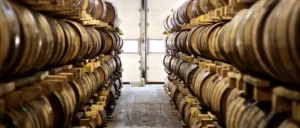
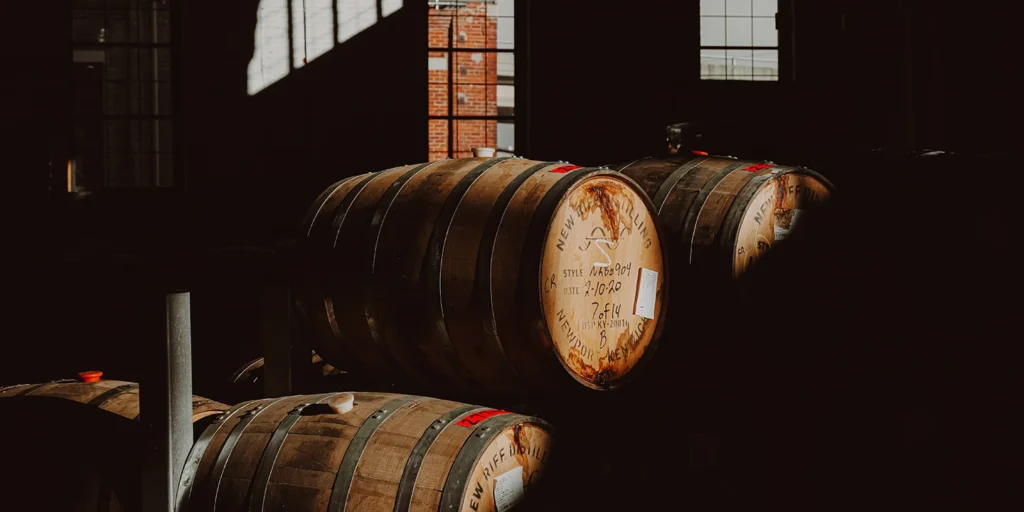
Additionally, the distilled Bourbon must be aged in new charred oak barrels. Though the law doesn’t specify the species of oak, most distilleries use white oak because it is most suited to building a secure, watertight barrel..
It gets even more complicated than this. To be considered “straight Bourbon,” it must be aged for a minimum of two years in new charred oak containers. If it is aged for less than four years, it must have an age statement somewhere on the bottle that tells buyers how long it was aged.
Some Bourbon may also be bottled in bond, the label for American-made distilled spirits that are aged and bottled according to certain federal standards. Many enthusiasts see this label as an endorsement of quality.
When you purchase a bottle of straight Bourbon that doesn’t state how old it is, you’re likely getting Bourbon that is at least four years old but not much older.
Production Basics
The Bourbon industry has undergone significant development and growth over the years. Bourbon distilleries produce Bourbon that is of great quality and value. However, many new enthusiasts still don’t know how Bourbon is made. Here are the basics; read on to learn the details.
Mash bill of at least 51 percent corn
As stated above, Bourbon has to have a mash bill of at least 51 percent corn. Other grains that make up Bourbon can include rye, wheat, or malted barley.
Aged for at least two years for “straight”
Straight Bourbon has to be aged in new charred oak barrels for at least two years.
Distillation proof of no more than 160
Bourbon must be distilled no higher than 160 proof, 80 percent alcohol-by-volume. Some whisky allows up to 90 percent alcohol-by-volume, but Bourbon does not. 160 proof Bourbon is as high as the proof can reach off the still.
Barreled no higher than 125 proof
Bourbon has to be barreled at no more than 125 proof.
Bottled no less than 80 proof
Bourbon has to be bottled at no less than 80 proof, or a minimum of 40 percent alcohol-by-volume.