
Drinking whiskey has been popular in the United States since colonial times. Yet Bourbon, while often referred to as “America’s native spirit”, has become even more popular of late. All Bourbon is whiskey but not all whiskey is a bourbon. Confused yet? Don’t worry, the experts at New Riff Distilling have developed a comprehensive guide to a few basic definitions for the most common words seen on bourbon labels. Today, we focus on the difference between Bourbon whiskey and straight bourbon whiskey.
Guide to Bourbon
The term “Bourbon” is legally protected under Title 27 of the Code of Federal Regulations as acknowledged in 1964 by the US Congress. For whiskey to be considered Bourbon, the following criteria must be met:
- Bourbon whiskey must be made in the United States.
- Bourbon must have a mash bill of at least 51% corn.
- The mash must be distilled at no higher than 160 proof.
- Bourbon must be barreled at no higher than 125 proof.
- Each barrel must be made of new charred oak.
- Bourbon must be bottled at no less than 80 proof.
Straight Bourbon
Under United States law, “Straight” Bourbon is whiskey that meets all the above requirements of Bourbon, but is aged for a minimum of two years.
The differences between straight Bourbon whiskey and non-straight Bourbon whiskey are the modifications that are permitted. With Kentucky straight bourbon, the only allowed modifications prior to bottling include batching whiskey from different barrels (and oftentimes other distilleries from within the same state), chill filtering or other filtration regimens, and adding water to reduce proof while maintaining a minimum of 80 proof, or 40% ABV concentration. Also, no coloring, flavoring, or other blending materials may be added to a straight whiskey.
The term “Straight Whiskey” is defined and established for production of American whiskey for consumption in the United States according to the US Federal Standards of Identity for Distilled Spirits. However, these specific regulations are not necessarily applicable to American whiskeys that are made for export. Several different types of whiskey are permitted to be labeled as straight whiskey, including Bourbon, Rye, Wheat Whiskey, Malt Whiskey, and Rye Malt Whiskey.
Aging Requirements
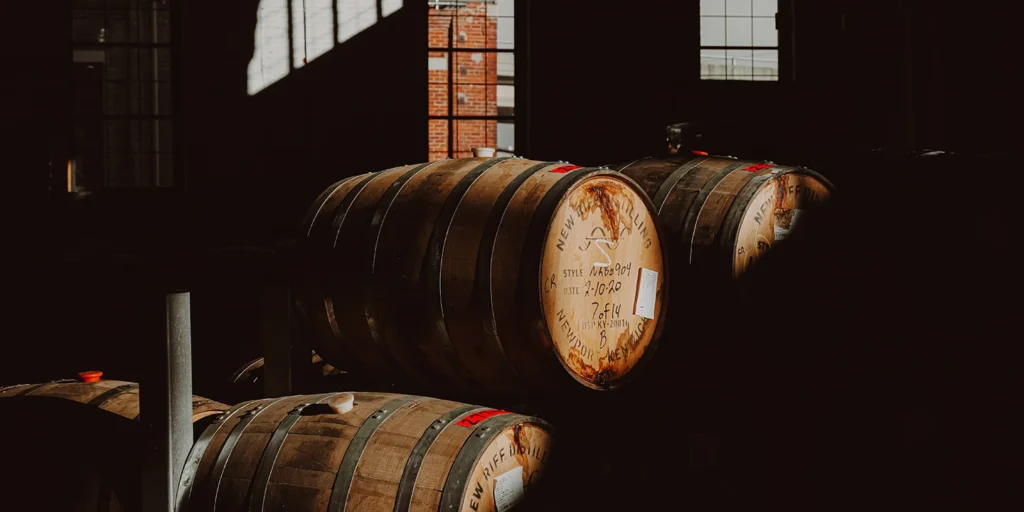
The primary requirement that defines bourbon as straight is if the distillate has spent a minimum of two years stored in new charred oak barrels. The only exception to this rule is corn whiskey, which is aged in uncharred or used oak barrels.
During the aging process, Bourbon oxidizes and penetrates the wood. This oxidizing extracts many of the flavor compounds such as caramelized sugars, giving Bourbon its sweet and smoky flavor notes.
Straight whiskey that is aged for less than four years is required by law to be labeled with an age statement that describes the actual age of the whiskey that is bottled. Other than the age statement, the only other label that relates to the age of whiskey is the “Bottled in Bond” label. All bonded whiskeys are required to be aged for at least four years.
Limits of Distillation
The secondary difference between Bourbon whiskey and straight Bourbon whiskey is that there is an 80% ABV (160 proof) concentration limit for the distillation of straight whiskey. A distillation that exceeds this alcohol content removes many of the flavors from the original fermented mash that was used in the distillation process. As a result, the spirit has a more neutral grain flavor profile.

New Riff Straight Bourbon
New Riff Distilling’s core Bourbon expression is a genuinely high-rye, full bodied whiskey offering savory, spicy character. Building upon America’s 1897 Bottled-in-Bond Act—already the highest quality standard for aged spirits in the world—New Riff Bourbon is Bottled In Bond Without Chill Filtration. Featuring a mash bill of non-GMO grains at 65% corn,30% rye, and 5% malted barley, it represents a new riff on Kentucky’s most hallowed whiskey traditions.Discover the best variety of our flagship bourbons and other spirits today.